Are We Losing Our Kids to the Algorithm? Four Experts Explore the Digital Dilemma
By Techweek Team
6 June 2025
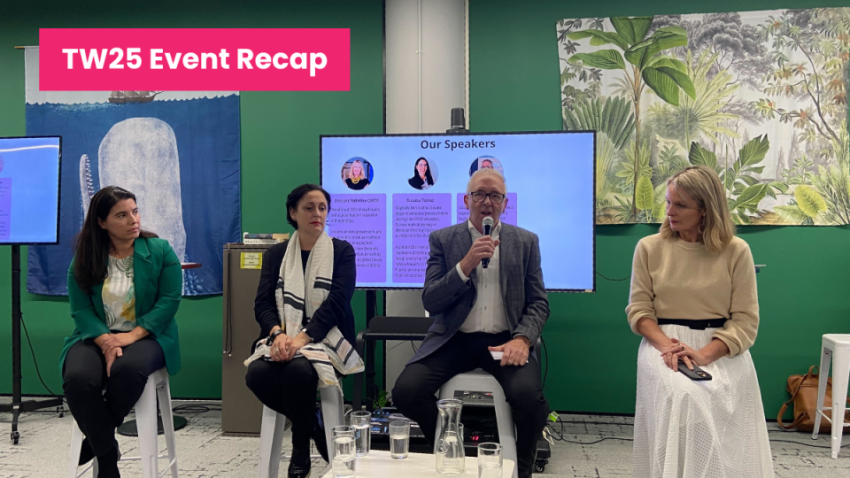
The "Are We Losing Our Kids to the Algorithm?" panel event at Techweek25 tackled one of the most pressing concerns facing parents, educators, and society at large: the impact of social media and technology on young people's wellbeing. Hosted by academyEX at their Auckland premises, the session brought together four experts with diverse perspectives on how algorithms are shaping our children's digital experiences and what we can do about it.
The Scale of the Challenge
Frances Valintine, founder and CEO of academyEX, opened the session with sobering statistics about young people's digital consumption.
"33% of teens spend four or more hours online on average per day," Valintine noted. "For the super users in New Zealand, which is typically those aged between 13 and 18, it’s common to spend eight hours online outside of school."
This level of engagement means many young people are effectively working "another whole job" after school hours, leaving little time for sport, social activities, or family engagement. Even more concerning are the emotional impacts, with Valintine citing that "80% of teens experience emotional responses to unwanted digital communications."
The session included a real-time experiment where an audience member set up a TikTok account as a 16-year-old and began scrolling. Within just 30 minutes, without liking or engaging with any content, the feed began showing increasingly provocative material, including content about guns and military personnel.
The Addictive Nature of Social Media
Martin Hughes, a coach and educator with over 20 years of experience helping schools use IT effectively, framed the issue in terms of addiction and its impact on brain development.
"I don't think we're losing our kids—I think we've already lost them, and I think we've already lost quite a few adults as well," Hughes stated bluntly. He highlighted how technology acts as an "experience blocker," preventing young people from developing essential life skills.
Hughes explained the connection between deferred gratification and success in later life: "There is a straight line correlation between deferred gratification and success in later life. This is a muscle that every human needs. These devices actively undermine our capacity to develop it."
This perspective was echoed by Paula Gair, an educator and advisor on AI, privacy, cybersecurity, and online safety, who described the neurological impact of social media.
"Our brains have been hacked, that we are drugged by dopamine, and this is affecting all parts of our lives," Gair explained. She noted how this addiction manifests in everyday life: "Every time I walk down the street, most of the people I walk past are staring down at their phones."
The Gender Divide in Digital Impact
A significant theme that emerged was the different ways social media affects boys and girls. Valintine presented data showing girls report greater negative impacts on mental health, sleep, and productivity compared to boys. Susana Tomaz, who leads AI strategy at Westlake Girls High School, confirmed this gender disparity from her frontline experience.
She also highlighted an alarming statistic from her own research: "81.2% told me that they've never been shown how to use [AI] responsibly." This knowledge gap leaves young people vulnerable to both the negative effects of social media algorithms and emerging AI technologies.
The Changing Nature of Childhood
The panel discussed how childhood experiences have fundamentally changed compared to previous generations. "Every child deserves a New Zealand childhood. That was true then. I'm not sure if it's true now,” said Hughes.
He explained how critical development happens through low-stakes mistakes: "That period of time should be a sequence of low stakes mistakes that kids need to fix themselves." The panel noted that today's children are "overprotected from the real world and underprotected in the digital world."
Valintine shared a powerful video from German Telecom showing how parents' digital sharing of their children's lives could have unforeseen consequences as AI technologies advance. The video depicted a future where childhood images shared online could be manipulated for identity theft, scams, or cyberbullying.
Practical Solutions for Parents and Educators
The panel offered several practical approaches for addressing digital overuse:
1. Focus on family activities rather than restrictions
The panel recommended reframing the conversation: "Instead of saying, you can't do this, you can't do that, it's, hey, we're gonna go and do this as a family." She emphasised that physical activities make device use physically impossible and provide positive neurochemical alternatives to digital dopamine hits.
2. Lead by example with phone free time
"No phones around, definitely not at meal times. If you go out together as a family, no phones," the panel advised, acknowledging this can be challenging for parents but is essential for modelling healthy relationships with technology.
3. Discuss exploitation and unfairness
Panellists suggested engaging young people around how their attention is being exploited: "There is opportunity to teach our kids about how the world works. If everything is free, they need to understand what that actually means. It is not free."
4. Collaborate with other parents
The panel emphasised the importance of a collective approach: "Knowing, connecting with parents of your child's friends is really important."
5. Support policy changes
The panel discussed the under-16 social media ban campaign that has gained traction in Australia and is now being considered in New Zealand. The panel hoped this could give parents "some ammunition to get kids off" platforms.
The Way Forward
The session concluded with a sense that addressing this challenge requires both individual action and broader societal changes. Valintine emphasised the need for hard conversations with young people about the physical and mental impacts of excessive screen time, while Tomaz highlighted the importance of education around critical thinking and media literacy.
Hughes summed up the urgency of the situation: "There is so much urgency with this. There is so much urgency even dealing with where things are today, never mind the exponential change of what's coming tomorrow."
As new AI chatbots and voice assistants become more integrated into young people's lives, the panel warned that these technologies present both new opportunities and risks. Valintine demonstrated how different AI systems respond to the same query, with some providing appropriate guidance while others quickly veered into inappropriate territory even when using "safe mode" settings.
The message was clear: parents, educators, and society must work together to help young people navigate an increasingly complex digital landscape while ensuring they don't lose the essential human experiences that shape healthy development.
Tools and resources for parents to find out more:
Subscribe to the Techweek newsletter for updates straight to your inbox:
Recent news

The Niu Wave: Tech Futures — rangatahi, resilience, and rewriting the rules of who tech is for
26 Jun 2026
At Techweek26, The Niu Wave: Tech Futures produced by The Southern Initiative and Te Ngahere created a powerful space for rangatahi and whānau to hear directly from Māori and Pasifika…

Mayoral Celebratory Event: honouring Auckland’s Hi‑Tech Awards finalists
26 Jun 2026
As Techweek26 built toward its final nights of celebration, Auckland Council brought the sector together for something new: a Mayorals celebration to recognise the 29 Auckland-based finalists heading into the…

We can't hire our way out of this: Demographics, productivity and the AI choices facing New Zealand (event recap)
26 Jun 2026
At Techweek26, principal sponsor Deloitte hosted a conversation with an intentionally blunt title: We can’t hire our way out of this. The focus landed quickly.