We can't hire our way out of this: Demographics, productivity and the AI choices facing New Zealand (event recap)
By Techweek Team
26 June 2026
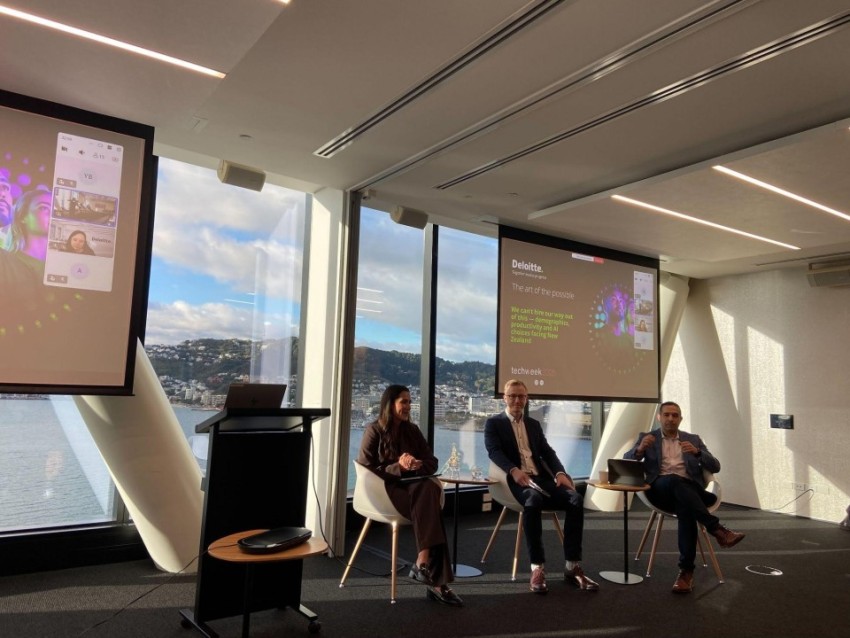
At Techweek26, principal sponsor Deloitte hosted a conversation with an intentionally blunt title: We can’t hire our way out of this. The focus landed quickly. New Zealand is moving into a period where the shape of work will change faster than our traditional planning cycles, and where labour constraints will collide with rising demand in critical services.
The discussion brought together perspectives across people and change, workforce transformation, and operational performance. The tone of the event was practical rather than predictive, with a shared acknowledgement from the outset: even if we repeated the discussion in two weeks, some answers would likely shift. That’s the reality of an AI-enabled transition.
The problem is not just labour. It’s labour, productivity, and skills at the same time
When the panel consisting of Deloitte New Zealand team members, Grace Schaaf, Senior Consultant, Josh Mcleod, Associate Director, Rory Mathew, Partner and Alexandrea Kozlova, Talent Experience Lead, unpacked what "we can't hire our way out of this" really means, one key takeaway was clear: current workforce planning is not a single-issue challenge.
New Zealand is facing:
- structural labour pressure from an ageing population and constrained supply
- increasing competition for global talent as other countries face the same demographic shifts
- a persistent productivity challenge, where we work long hours but don’t always lift output
- a significant skills mismatch that could widen if AI adoption remains limited
The panel described AI as less of an optional upgrade and more as critical to national capability. If Aotearoa wants to sustain public services and economic performance with fewer people available, improving output per worker is critical.
AI is a people challenge first, not a technology challenge
One of the strongest recurring discussion points on the day was that AI transformation will fail if it’s treated as a tools rollout.
The panel argued that leaders can’t assume adoption happens automatically. Getting real value from this technology takes deliberate change management, workflow redesign, and investment in capability building. In fact, one statistic shared in the conversation from Deloitte Global’s recent Human Capital Trends report captured the imbalance many organisations are living with: 93% of AI spend going into technology, and only 7% into change and people capability.
The panel view was that this ratio needs to flip if organisations want meaningful returns from AI. Tools are not the hard part. The hard part is redesigning how work happens and taking people with you.
Workforce strategy can’t rely on five-year certainty anymore
A tension point was raised for leaders: most organisations still plan strategy over five to ten years. AI is evolving on a timeframe that makes that feel increasingly unrealistic.
Being unable to plan ahead creates a workforce dilemma. Skills planning, training programmes, and organisational design rely on stability. But if the work itself changes every few months, leaders need to plan differently. The panel suggested the shift is away from hiring for static skills and towards hiring for traits that stay valuable under constant change: curiosity, initiative, adaptability, creativity, and critical thinking.
At the event, there was also a strong point raised about leadership itself. Many leaders have reached their roles by being experts in a stable domain. AI changes that. Leaders are now expected to guide their organisations through a technology shift they didn’t have the chance to “grow up with,” which means capability building is needed at the top as much as anywhere else.
Start with service redesign, then layer AI on top
When the discussion turned to practical action, one message came through consistently: if you apply AI to broken workflows, you often just make the broken work happen faster.
The panel favoured a service redesign approach instead:
- map the work as it actually happens
- remove failure demand and reduce handoffs
- automate repetitive intake and documentation where appropriate
- redeploy people into work that requires judgement, empathy and human conversation
- then scale AI where it improves outcomes and quality
This method was framed as a shift from “adding more people” to “designing better systems.” In constrained sectors like health and government, that matters. AI can be used to reduce low-value admin burden, and support human professionals to focus on the decisions and care that only humans can provide.
Skill mismatch is already costly, and AI can either help or worsen it
The panel also grounded the conversation in labour market data.
The implication of this gap is major. Skills mismatch is linked globally to lost productivity. The panel discussed how AI could widen the gap if only a small percentage of workers become “AI capable,” but it could also help close the gap if it becomes a tool that supports learning, improves access to capability, and enables people to move into higher-value work faster.
A related insight was the rise of the “digital translator” role: people who can embed AI into real workflows, bridge technical and non-technical teams, and make adoption real in day-to-day operations. Those integrators will be in growing demand.
A real risk: losing critical thinking pathways for early-career talent
At the Deloitte Techweek event, one concern came up around critical thinking and experience. If AI takes over much of the early-career “apprenticeship” work, how do new entrants build the deep context needed to challenge outputs later on?
The panel painted a picture of a future risk where fewer people develop the judgement that comes from time working, which could weaken an organisation’s ability to spot when something is “written compellingly” but wrong in practice.
The answer wasn’t to avoid AI. It was to redesign pathways so early-career workers still build experience, and so critical thinking is deliberately nurtured.
The economics are shifting, and costs could reshape adoption
The conversation also touched on a fast-moving factor many organisations have not planned for: AI pricing models.
A real example was discussed by the panellists where consumption-based pricing can turn a flat monthly cost into a significantly higher bill if usage scales. The takeaway for leaders was not to panic, but to be intentional. Use cases matter. Model choice matters. Deep adoption needs financial discipline, especially for small and medium businesses.
The group also noted that over time, some AI capability may shift “to the edge” (running locally on devices) for both cost and sustainability reasons.
Ethics, sustainability, and trust are not side issues
Another strong thread was that ethics and environmental impact are not being considered enough in many decisions..Data centres use huge amounts of water and electricity, and concerns about trust can quickly put people off - particularly younger workers.
The panel used the term, “the genie is out of the bottle,” so the responsibility now is to build safer systems, clearer guardrails, and better governance. It’s not about stopping adoption. It’s about doing it with integrity.
Three practical closing ideas: think, stay relevant, test and learn
The session closed with three simple ideas that brought the conversation back to action:
- Critical thinking: be deliberate about where AI fits and where it doesn’t
- Relevance: keep organisations productive, while supporting people to stay employable as work shifts
- Test and learn: run experiments, validate what works, and iterate as the next wave arrives
What made this event stand out in the wider Techweek programme was its clarity. New Zealand’s constraints are real. The opportunity is real too. But the path forward will require more than new tools. It will require better system design, stronger leadership capability, and a sustained commitment to people through change.
Deloitte was the principal sponsor of Techweek and hosted this conversation in Wellington, which focused on the changing shape of work in Aotearoa.
Subscribe to the Techweek newsletter for updates straight to your inbox:
Recent news
The Niu Wave: Tech Futures — rangatahi, resilience, and rewriting the rules of who tech is for
26 Jun 2026
At Techweek26, The Niu Wave: Tech Futures produced by The Southern Initiative and Te Ngahere created a powerful space for rangatahi and whānau to hear directly from Māori and Pasifika…
Mayoral Celebratory Event: honouring Auckland’s Hi‑Tech Awards finalists
26 Jun 2026
As Techweek26 built toward its final nights of celebration, Auckland Council brought the sector together for something new: a Mayorals celebration to recognise the 29 Auckland-based finalists heading into the…
TW26 x Xero Webinar: Bridging the confidence gap on AI adoption for Kiwi business owners (recap)
23 Jun 2026
As part of Techweek26, Xero hosted a webinar on a challenge that’s showing up in thousands of Kiwi businesses right now: AI is moving quickly, but confidence is not always…