TW26 x Xero Webinar: Bridging the confidence gap on AI adoption for Kiwi business owners (recap)
By Techweek Team
23 June 2026
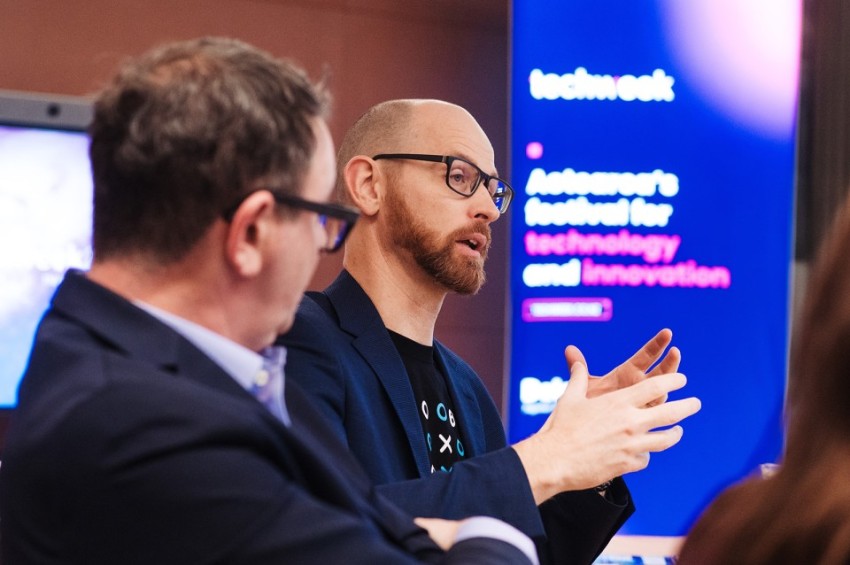
As part of Techweek26, Xero hosted a webinar on a challenge that’s showing up in thousands of Kiwi businesses right now: AI is moving quickly, but confidence is not always keeping pace.
Facilitated by Madeline Newman (Executive Director, AI Forum New Zealand), the session featured James Bergin (Executive GM – Tech Research & Advocacy, Xero) and unpacked fresh New Zealand data on how small businesses are using AI, what’s holding others back, and what it takes to move from curiosity to capability.
The headline: AI is already saving time for Kiwi SMEs
Xero’s research surveyed 1,081 New Zealand small and medium businesses in early April, with results weighted to be representative across the country.
Two stats stood out early in the discussion:
-
64% reported time savings, averaging around one day per week
-
Over 60% were using AI in some form, often through trial and error
The framing from both speakers was grounded: many businesses are still at the beginning of their journey, but even early experimentation is producing measurable value.
Four archetypes, one shared reality: “context is everything”
The webinar explored four AI adoption archetypes identified in the research:
-
Explorers (the largest group, 44%)
-
Trailblazers (15%)
-
Pragmatists (15%)
-
Sceptics (26%)
James made an important point about these categories: they are not a simple maturity ladder. People can move between them depending on the week, the task, or their risk appetite. One business owner even described themselves as a “sceptical trailblazer.”
Across all groups, the most common use cases were consistent:
-
research and learning (67%)
-
proofing and sharpening business communications (62%)
-
general admin (55%)
-
marketing and content creation (54%)
But the real message was that AI value is highly contextual. What works for one business may not translate to another, and “relevance” depends on how well a tool fits the way the business actually runs.
From “bolting on” to “baking in”: why process matters
A key thread through the session was that AI adoption is not just a tech decision. It’s a people and process decision.
James returned to a simple definition of a system: people, process, and technology. AI tools are changing fast, but people and processes do not automatically change at the same speed.
For “explorers” especially, the opportunity is to move beyond using AI as an add-on and start embedding it into workflows. That starts with understanding the business’s core processes and targeting AI where it can remove friction, reduce rework, and free up capacity.
Madeline reinforced that point from the AI Forum’s perspective: start with the business problem. Sometimes the answer is AI. Sometimes it’s not. Either way, clarity on the problem comes first.
Healthy scepticism, and the guardrails that help teams move
The session treated scepticism as a valid stance, not a problem to dismiss.
For many sceptics, the barriers weren’t ideological. They were practical:
-
concerns about data privacy and security (54%)
-
overreliance on technology (54%)
-
concerns about accuracy (53%)
James described the opportunity here as building “rules inside your business” that allow safer exploration. That could mean setting boundaries on what data can be used, or choosing different methods that reduce risk.
One practical example discussed was sharing an Excel schema rather than raw customer data, and using AI to generate formulas or scripts without exposing sensitive information. The underlying message was that AI use isn’t “all or nothing.” There are safer ways to test value.
The confidence gap is real, and time-poor owners need practical help
For pragmatists, a major barrier was simple: lack of time. Many were interested and even testing tools, but didn’t have the capacity to explore properly.
Both speakers emphasised the demand for practical support. The research pointed to the most useful forms of help being:
-
hands-on training and workshops
-
access to trusted, vetted tools
-
real-world examples from other small businesses
Xero’s response was to partner with ASB and AcademyEX to launch a fully funded 12-week AI bootcamp for Kiwi SMEs, designed to build real-world skills and help owners translate tools into day-to-day productivity.
Experimentation needs a method, not just curiosity
One of the most actionable ideas from the webinar was James’s reframing of “experimentation.”
Many of us say we are experimenting with AI, but not in a disciplined way. He suggested going back to a simplified scientific method:
-
start with a hypothesis (where do we expect AI to add value?)
-
test it with a clear method
-
gather both quantitative results and qualitative observations
-
iterate, because what’s true today may change quickly
This approach was positioned as a way to build confidence through evidence, not hype.
Augmentation, not replacement: redeploying time into growth
The discussion also returned to what happens after time is saved. Madeline noted that the biggest workforce impact right now is not AI “taking jobs,” but business decisions about how freed-up capacity is redeployed.
James described the opportunity as the classic tension of working in the business versus working on the business. If AI creates breathing room, leaders can reinvest that time into growth, customer experience, innovation, or capability building.
Both speakers kept coming back to one word: augmented. The goal is not to replace people, but to extend what people can do.
Shaping a “preferred future”
The conversation closed with a futures lens James has used throughout his career: the future is not something we predict, it’s something we shape.
For small business owners, the “preferred future” will look different depending on context. The real question is whether AI brings a business closer to that preferred future, or pulls it away. That framing grounded the session in something more durable than any tool cycle.
Because tools will keep changing. The capability to choose, test, and adopt with confidence is what will last.
Check out Xero’s latest research here
Xero is a strategic sponsor of Techweek26
Subscribe to the Techweek newsletter for updates straight to your inbox:
Recent news

The Niu Wave: Tech Futures — rangatahi, resilience, and rewriting the rules of who tech is for
26 Jun 2026
At Techweek26, The Niu Wave: Tech Futures produced by The Southern Initiative and Te Ngahere created a powerful space for rangatahi and whānau to hear directly from Māori and Pasifika…
Mayoral Celebratory Event: honouring Auckland’s Hi‑Tech Awards finalists
26 Jun 2026
As Techweek26 built toward its final nights of celebration, Auckland Council brought the sector together for something new: a Mayorals celebration to recognise the 29 Auckland-based finalists heading into the…
We can't hire our way out of this: Demographics, productivity and the AI choices facing New Zealand (event recap)
26 Jun 2026
At Techweek26, principal sponsor Deloitte hosted a conversation with an intentionally blunt title: We can’t hire our way out of this. The focus landed quickly.