Building Digital Foundations: How Infrastructure, AI and Inclusion Can Supercharge Aotearoa
By Techweek Team
20 May 2025

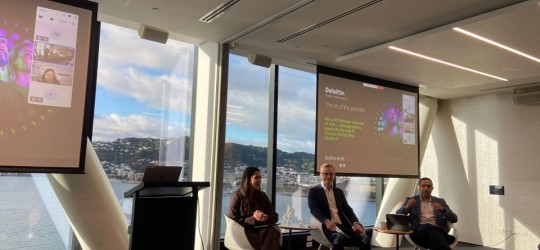
The first panel at our Techweek25 Launch event: Collective Imagining: a brighter, tech-enabled future for Aotearoa, brought together experts from across the tech ecosystem to explore the digital foundations that could transform New Zealand's productivity, inclusion, and global competitiveness. Moderated by Kate Phillips, Partner at Deloitte, the powerhouse panel featured Pete Herlihy, Global Lead for Digital Public Infrastructure at AWS; Dr. Amanda Williamson, Generative AI Lead at Deloitte; and Paul Churchman, Head of Partner Sales at Xero.
Digital Public Infrastructure: The Plumbing of a Digital Nation
Pete Herlihy, who helped build the UK Government Digital Service and now supports governments worldwide, provided a comprehensive overview of what digital public infrastructure (DPI) actually means for New Zealand.
"It's the shared digital capability that a nation needs, provided almost as a utility for the nation to use," Burley explained. "I don't just mean government—that's a really important use case for it—but it's also the rest of the digital economy that can leverage it."
Drawing parallels with physical infrastructure like water and waste treatment, Burley described DPI as "the undifferentiated heavy lifting" that every sector needs but shouldn't have to build individually. New Zealand already has some elements in place—open banking, e-invoicing, and parts of a digital identity system—but there's significant room for growth.
The economic impact could be substantial. According to Herlihy, widely adopted digital public infrastructure typically delivers between 1-2% GDP growth in developed nations, while in developing countries, solutions like digital identity can unlock 6-7% GDP growth by enabling financial inclusion.
AI as the Enabler of Inclusion
Dr. Amanda Williamson highlighted how artificial intelligence can help overcome barriers to digital inclusion, making technology more accessible to all New Zealanders.
"There's real power in AI to find patterns in data that we might not otherwise see," Williamson explained. Beyond the chatbots that dominate public discussion, AI can identify bias in data, help match incompatible systems, and make digital services more accessible to those with different levels of digital literacy.
For people with disabilities or those who speak less common languages, AI can transform content into accessible formats. "We can start to use AI to translate things for them, to take things that are perhaps not readable or not audible, and switch it around the other way very, very easily," Williamson noted.
The Productivity Challenge for Small Business
Paul Churchman from Xero brought the conversation back to the practical challenges of digitisation, particularly for small businesses. Reflecting on Adrian Smith's earlier points about usability and inclusivity, Paul emphasised that while the technology exists, adoption remains a significant barrier.
"Everyone in this room is tech-forward... but there are many workplaces in NZ that still don't have computers on every desk," he observed. "Ten years ago, I worked with an organisation that still paid for everything by cheque because the previous treasurer had done it for twenty-five years and never changed things."
This highlights a key challenge in New Zealand's digitisation journey: the "it's not broken, don't fix it" mindset. Small businesses often recognise the potential benefits of digital tools but lack the time to implement them—creating a negative cycle that hampers productivity growth.
Emerging Roles in a Digital Economy
Looking to the future, the panel discussed how digital infrastructure and AI will create entirely new job categories. Dr. Williamson highlighted the emergence of dedicated ethics roles in AI development.
"One thing I'm seeing in the AI space are people who just think about ethics and that's their whole role," she explained. These specialists address fundamental questions about how AI systems should operate when human bias can be measured and potentially removed.
Churchman offered a different perspective, suggesting we should focus on what jobs AI cannot do. "What jobs can't some of the AI and the tech do?" he asked, suggesting that human engagement and relationship-building will remain crucial even as mundane tasks are automated.
Herlihy predicted a surge in startup activity enabled by digital infrastructure: "If you don't have to take care of identity and payments of moving data around... the cost of entry and experimentation drops." This could create opportunities across all sectors, from agritech to healthcare.
Barriers to Progress
When asked about barriers to progress in the next 2-3 years, the panel identified several key challenges:
-
Skills shortage: Dr. Williamson expressed concern about insufficient numbers of New Zealanders pursuing technology careers, creating a supply-demand gap.
-
Digital sovereignty: Herlihy highlighted how questions of control and ownership—whether data sovereignty or indigenous data sovereignty—are increasingly important considerations in infrastructure development.
-
Usability and education: Herlihy emphasised that despite rapid advancements in AI, the real challenge lies in education and adoption—ensuring people understand and can use these tools effectively.
"AI is the new UI." — Kate Phillips, Deloitte (panel facilitator)
Looking Ahead: Commitments for Change
The panel concluded with each participant sharing their organisation's commitments for advancing digital infrastructure in the coming year:
-
Deloitte will launch an AI Institute to help New Zealanders understand what AI means for them and work with the ecosystem to move the dial forward.
-
AWS is working with the New Zealand government and tech businesses to accelerate infrastructure development, avoiding the "rinse and repeat pattern" of traditional tech procurement.
-
Xero is focused on bringing AI to as many small businesses as possible in a usable manner, with their AI agent already helping customers automate mundane tasks.
What's Next
As Techweek continues, stand by for more powerful insights on building the digital foundations that will drive New Zealand's future prosperity. Check out the full programme.
Subscribe to the Techweek newsletter for updates straight to your inbox:
Recent news

The Niu Wave: Tech Futures — rangatahi, resilience, and rewriting the rules of who tech is for
26 Jun 2026
At Techweek26, The Niu Wave: Tech Futures produced by The Southern Initiative and Te Ngahere created a powerful space for rangatahi and whānau to hear directly from Māori and Pasifika…
Mayoral Celebratory Event: honouring Auckland’s Hi‑Tech Awards finalists
26 Jun 2026
As Techweek26 built toward its final nights of celebration, Auckland Council brought the sector together for something new: a Mayorals celebration to recognise the 29 Auckland-based finalists heading into the…
We can't hire our way out of this: Demographics, productivity and the AI choices facing New Zealand (event recap)
26 Jun 2026
At Techweek26, principal sponsor Deloitte hosted a conversation with an intentionally blunt title: We can’t hire our way out of this. The focus landed quickly.