Digital Adoption: The $8.6 Billion Opportunity for Small Businesses in Aotearoa
By Techweek Team
22 May 2025
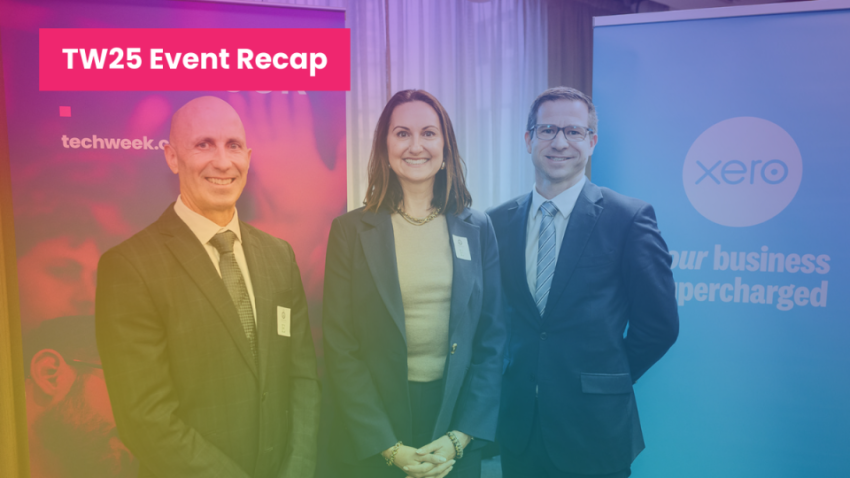
The "Powering Productivity: How Tech is Transforming Small Business in Aotearoa" webinar at Techweek25 revealed a startling statistic: if just one in ten Kiwi businesses adopted a cloud tool, we'd see a 3.5% lift in productivity across New Zealand. This webinar was
Hosted by Graeme Muller, CEO of NZTech, the session brought together Bridget Snelling, Country Manager of Xero, and Josh Wilson, Director of The Software Coach, to explore how digital tools can transform small business productivity and what's holding many back from making the leap.
The $8.6 Billion Opportunity
Bridget Snelling opened with insights from Xero's newly released "Going Digital 2025" report, commissioned from the New Zealand Institute of Economic Research (NZIER), which highlighted a significant economic opportunity for Aotearoa. These findings were released as part of Techweek25 at a closed door roundtable with the Minister for Small Business, Hon. Chris Penk, alongside government officials and industry leaders to present the case for purposeful support for small business digital adoption
"What the report tells us is that there is a huge opportunity for Aotearoa New Zealand when it comes to increasing our GDP through the SME sector adopting and utilising digital tools," Snelling explained.
The numbers are compelling: New Zealand is currently leaving $8.6 billion on the table through untapped potential in small business productivity. With SMEs making up 97% of all businesses in New Zealand and accounting for about a quarter of GDP, their digital transformation represents a significant economic opportunity.
"A ten percentage point rise in cloud uptake is linked to a 3.5% jump in average firm productivity," Snelling highlighted. "Over 70% of SMEs using digital analytics report stronger strategic decision-making capabilities."
The Mindset Barriers to Tech Adoption
Despite the clear benefits, many small businesses remain hesitant to adopt new technologies. Snelling identified three key mindset barriers that prevent businesses from embracing digital tools:
-
Perceived Sufficiency – The "what I'm doing today is good enough" mentality. "I might be using a spreadsheet for something. I know that a counterpart down the road, a similar business, is probably using a digital tool and being more efficient than I am. But my system works okay, so why would I change it?" Snelling explained.
-
Fear of Cost or Failure – Concerns about ongoing subscription fees, uncertain returns on investment, and potential short-term disruption. "What if it doesn't work out? And what if my team can't use the tools?" Snelling noted, while emphasising that "long term, the efficiency gains are so enormous."
-
Decision Overload – With so many tech options available, many businesses experience decision paralysis. "How do I know which one is the right one for me? How do I know that's the right tech stack for me in my industry?" Snelling explained. "Sometimes because it's so overwhelming, it's just easy for people to do nothing."
Technology as an Employee
Josh Wilson offered a refreshing perspective on how businesses should approach their technology investments, suggesting they should be treated like employees with clear performance expectations.
"You need to treat it like an employee. You need to have KPIs for it or things that you're looking at to go, okay. Is it performing the way I want it to? Is my team enjoying using it?" Wilson advised.
This approach includes regular check-ins and ongoing training: "Has there been a development in the system that perhaps I haven't trained the team on? So if you're getting updates about systems you're using, make sure you're sharing that with your team."
For businesses that haven't started their digital journey, Wilson recommended learning from peers: "What are my peers doing in the industry? If you've got good relationships with other people in the same industry as you, what programs are they using? What have they found that works well? What doesn't work well?"
Starting Small for Big Gains
A key message from both speakers was the importance of starting with small, focused changes rather than attempting a complete digital transformation overnight.
"It's not necessarily about completely throwing out all your processes and starting again," Wilson explained. "Look at the little parts where you're going, this part's taking too long, or we're using paper for this, or we're using Excel for this. What could we do, what could we put in place that would replace some of those things and really give some great practical wins."
Snelling added that businesses should consider using AI tools to identify potential improvements: "Use ChatGPT or Gemini or one of these accessible tools and just type in, 'I'm a small business and whatever industry you're in — How could I use digital tools to become more efficient?' And you'll be amazed at what comes out."
Weighing the Risks
Wilson addressed concerns about the risks of moving to digital systems, particularly for businesses with paper-based records, by encouraging a more balanced risk assessment.
"There is a risk of changing tools and putting data online. But I think the other thing as a country we need to remember is like, I'm from Christchurch. And we all know what happens when we have a natural disaster, and what happens to paper-based records," Wilson pointed out.
"You need to weigh up the risk of using cloud tools versus the risk of keeping it all manual. Because there's so many ways all that data could suddenly disappear and your business can't carry on."
The Government's Role
The discussion also touched on what government could do to accelerate digital adoption among small businesses. Snelling highlighted successful models from other countries, particularly Canada and Singapore, which have invested significantly in supporting businesses to digitise.
"The Canada Digital Adoption Program provides financial grants of up to 2,400 Canadian dollars to help small businesses establish or enhance their e-commerce presence," Snelling explained. "Singapore's Go Digital Program subsidises up to 80% of the costs of pre-approved digital solutions."
While acknowledging New Zealand's current fiscal constraints, Snelling suggested that even without immediate funding, the government could provide clearer roadmaps and signals of intent: "Eventually, we do need investment into the sector. We know for small businesses there are mindset barriers, but cost is a major barrier too."
Building a Task Force for Digital Transformation
One practical recommendation that emerged from the report was expanding the Small Business Advisory Group (S-BAG).
"Our recommendation to [Minister Chris Penk] is actually, well, why doesn't the minister expand that group to include industry and academia and make it more of a task force that can look at the information in this report and other reports and pull together a framework for what policy could look like in New Zealand," Snelling explained.
Wilson emphasised the importance of including industry practitioners in this group: "It's super important to include those industry people as well, because it's not just the people that are the small businesses that need that work, but it's the people that are going to be actually on the ground doing it."
The Path Forward
As the session concluded, the speakers emphasised that digital adoption is not just about technology but about changing mindsets and building a supportive ecosystem for small businesses.
"At some point, you have to invest and strategically make a decision that this is a sector we are going to look after as a government," Snelling noted. "We've been having this conversation for years and there are no tangible differences now, from three years ago, in terms of how small businesses are faring with their digital adoption."
The message was clear: with the right support, tools, and mindset, New Zealand's small businesses can unlock significant productivity gains, contributing to the country's economic growth and global competitiveness.
Huge thanks to Xero for presenting this research and bringing this important conversation into the spotlight during Techweek25.
Subscribe to the Techweek newsletter for updates straight to your inbox:
Recent news

The Niu Wave: Tech Futures — rangatahi, resilience, and rewriting the rules of who tech is for
26 Jun 2026
At Techweek26, The Niu Wave: Tech Futures produced by The Southern Initiative and Te Ngahere created a powerful space for rangatahi and whānau to hear directly from Māori and Pasifika…
Mayoral Celebratory Event: honouring Auckland’s Hi‑Tech Awards finalists
26 Jun 2026
As Techweek26 built toward its final nights of celebration, Auckland Council brought the sector together for something new: a Mayorals celebration to recognise the 29 Auckland-based finalists heading into the…

We can't hire our way out of this: Demographics, productivity and the AI choices facing New Zealand (event recap)
26 Jun 2026
At Techweek26, principal sponsor Deloitte hosted a conversation with an intentionally blunt title: We can’t hire our way out of this. The focus landed quickly.