From Seaweed to Cell Sorting: How Waikato Innovation is Changing the World
By Techweek Team
19 May 2025
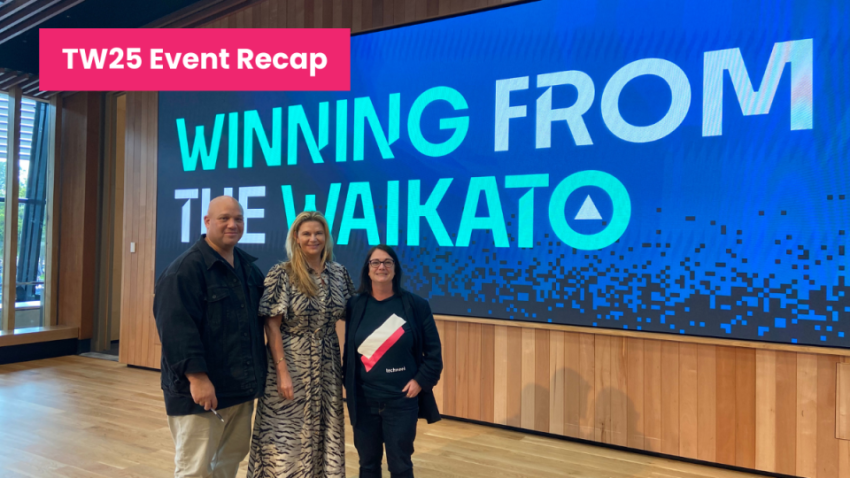
The "Winning in the Waikato" session held at The University of Waikato’s ‘The Pa’ during Techweek25 offered a rare glimpse into the innovative businesses that are quietly revolutionising industries from a region many might not associate with cutting-edge technology. Three remarkable leaders shared their journeys of building globally significant businesses from Waikato roots, proving that groundbreaking innovation can flourish anywhere in Aotearoa.
Starting with Truth, Not Trends
Clare Bradley, CEO of AgriSea, shared how her family's seaweed innovation company evolved from humble beginnings in Paeroa to becoming a global leader in seaweed-based solutions for agriculture and beyond.
"Our story starts almost thirty years ago with my beautiful mother-in-law who went WOOFing (working on organic farms) on holidays while she was a school teacher and saw the power of seaweed in agriculture," Bradley explained. This led to selling the family home in Auckland and moving to a shop in Paeroa with no running hot water—hardly the typical tech startup story.
What began as "buckets of seaweed, cold showers, and communities" has transformed into a sophisticated operation partnering with research institutions like Scion and the University of Waikato. Today, AgriSea is creating world-first innovations like seaweed nanocellulose from their biorefinery and turning dairy farm waste streams into valuable seaweed products.
Solving the 'Impossible' Problems
John Sharpe of ST Genetics and Cytonome shared his journey of developing revolutionary cell-sorting technology that's now used globally for everything from animal breeding to potentially curing Parkinson's disease.
"Through the various roles that I've had, there's been a theme of trying to solve really hard problems, often the ones that people think are not possible," Sharpe explained. His career path took him from the University of Waikato to the United States and back again, developing technologies that can sort cells travelling at 70 kilometres per hour with incredible precision.
What began as research at Ruakura has evolved into technology that allows New Zealand farmers to determine the sex of their dairy or beef offspring and is now being adapted to potentially provide curative treatments for diseases like Parkinson's. Sharpe's team is currently building a new facility in Riverlea, Hamilton, focused on advancing regenerative medicine capabilities.
From Crisis to Opportunity
Hilary Sharp, Chief Executive of ESP Medical, shared how their company pivoted during COVID-19 from manufacturing plastic products to developing medical devices—including an emergency ventilator created in just four weeks.
"When COVID came along, Jeff, the managing director of ES Plastics, went to his neighbours who were both emergency physicians at Waikato Hospital and asked what manufacturers could do to help," Sharp explained. The result was a remarkable collaboration where dairy industry technology was repurposed for medical use.
This crisis-driven innovation led to ESP Medical becoming a specialised contract manufacturer for life sciences companies. Today, they support startups developing everything from methane-reducing boluses for cattle to illuminated cannula devices for healthcare settings.
The Power of Ecosystem Collaboration
A common thread across all three stories was the importance of the Waikato innovation ecosystem. The region's unique combination of agricultural heritage, research institutions, manufacturing capabilities, and collaborative culture creates fertile ground for innovation.
"In the life sciences space, it really does take a village to take some of these projects off the ground," noted Hilary Sharp. "The business is coming together and really slimming down for one cause."
Clare Bradley emphasised how collaboration with the University of Waikato is enabling them to turn pollution into potential, while John Sharpe highlighted how the enduring trust-based relationships formed in the region are "a powerful weapon and a competitive advantage."
"We don't separate science from our story. We take our bold, local, traditional knowledge, mix that with collaboration, rigorous science, and deep tech." — Clare Bradley, CEO of AgriSea
What's Next for Waikato Innovation
These stories represent just a fraction of the innovation happening in the Waikato region. The region is quietly developing solutions to some of the world's most pressing challenges. Visit Tech in the Tron to find out more.
Check out the full programme and register for events happening through 25 May.

Subscribe to the Techweek newsletter for updates straight to your inbox:
Recent news
The Niu Wave: Tech Futures — rangatahi, resilience, and rewriting the rules of who tech is for
26 Jun 2026
At Techweek26, The Niu Wave: Tech Futures produced by The Southern Initiative and Te Ngahere created a powerful space for rangatahi and whānau to hear directly from Māori and Pasifika…
Mayoral Celebratory Event: honouring Auckland’s Hi‑Tech Awards finalists
26 Jun 2026
As Techweek26 built toward its final nights of celebration, Auckland Council brought the sector together for something new: a Mayorals celebration to recognise the 29 Auckland-based finalists heading into the…
We can't hire our way out of this: Demographics, productivity and the AI choices facing New Zealand (event recap)
26 Jun 2026
At Techweek26, principal sponsor Deloitte hosted a conversation with an intentionally blunt title: We can’t hire our way out of this. The focus landed quickly.