Resetting for the Future: How Science System Reforms Will Shape Aotearoa's Tech Landscape
By Techweek Team
22 May 2025

The "Science System Reforms – Impact and Opportunities for Tech in Aotearoa" session at Techweek25 offered a timely deep dive into the most significant overhaul of New Zealand's research, science, and innovation system in over 30 years. Hosted by NZTech and facilitated by Colby Raley, Public Sector Strategist at Microsoft New Zealand, the event featured Hema Sridhar, Director of Programmes and Government Relations at Koi Tū: The Centre for Informed Futures, who provided valuable insights into the reforms and their potential impact on New Zealand's tech sector.
A System Designed for a Different Era
Sridhar opened with a stark reminder of how outdated New Zealand's science system had become. "I'm going to start in 1991, or maybe 1992," she began, "there was no internet. There was no social media. There were no smartphones. There was nothing that we know of the world now," Sridhar explained. "But 1991 was the last time the New Zealand government fundamentally reviewed the science system for New Zealand."
This historical context highlighted why the current reforms are so essential. The existing system was designed for a world that no longer exists. The concept of innovation and startups didn't exist in the early '90s, making the system fundamentally unsuited for today's technology-driven economy.
Why Science and Innovation Matter for New Zealand
A central theme of Sridhar's presentation was establishing why science, research, and innovation are critical for New Zealand's future prosperity. Rather than beginning with funding discussions, the review team focused on articulating the fundamental value proposition.
"We started with essentially, what does the sector actually need and why is it important for New Zealand to invest in science and innovation and technology?" Sridhar explained. "The point that we couldn't really get from enough people was why was it worth fixing?"
The review found compelling evidence that science and research are at the core of a knowledge economy, driving productivity and economic advancement. Looking at successful small advanced economies similar to New Zealand, the team observed that all had invested significantly in science and innovation.
"They realise that if they didn't, they're not gonna succeed and they're not gonna compete with everyone else in the world," Sridhar noted, highlighting Israel's transformation from a country with productivity comparable to New Zealand in the 1970s to a global innovation leader today.
A New Framework for Research
One of the most significant contributions of the review was reframing how we think about research and its value to society. Moving away from the traditional basic-to-applied research spectrum, the review proposed four new categories:
-
Stewardship Research
Research that needs to be done because the country needs it, such as earthquake or flood zone research, with little incentive for private sector involvement. -
Policy Research
Research that informs government policy decisions, including social science research. -
Knowledge Generating Research
Research that expands our understanding without immediate commercial applications. -
Exploitable Research
Research with commercial potential, where the government has a role in addressing market failures but should eventually step back to allow private sector leadership.
"Reframing the structure of research was fundamental in being able to then have conversations around, well, if we had exploitable research, what's needed in order for the next Peter Beck to make the next Rocket Lab," Sridhar explained.
The New Architecture: Public Research Organisations
A major outcome of the review is the restructuring of Crown Research Institutes (CRIs) into Public Research Organisations (PROs). Instead of seven CRIs with overlapping capabilities (for example, aquaculture research was being conducted in three different CRIs), the new structure will have three main PROs plus a new Advanced Technology PRO.
"If you looked in the report, we came up with a new way to frame what research actually means and how it adds value to the country, to the economy, even globally," Sridhar explained.
This restructuring aims to reduce duplication, increase collaboration, and provide clearer mandates for each organisation. The Advanced Technology PRO, in particular, represents a significant opportunity for the tech sector, focusing on emerging technologies like AI and synthetic biology.
The Prime Minister's Science Advisory Council: Strategic Direction
Another key recommendation was the establishment of the Prime Minister's Science Advisory Council to provide strategic direction and help New Zealand anticipate and prepare for future challenges.
"You need people that sit at the very high levels to be able to dictate and set the direction of travel," Sridhar explained. "And it's something if you look globally, every other country has. New Zealand just hasn't had it."
This council will bring together knowledge from different parts of the sector to identify signals and trends, helping New Zealand make more informed decisions about where to invest and how to prepare for the future.
Sridhar pointed to AI as an example of where New Zealand could have been better positioned with more strategic foresight: "Maybe fifteen years ago is when we were on an emerging tech panel and we were talking about AI. That was fifteen years ago. We are still talking about AI. We're still thinking about what policies we need, regulation settings, and we're now scrambling to create the architecture to deliver this, yet the signals that AI was coming were already there about a decade ago."
Moving Beyond Cultural Baggage
A particularly thought-provoking part of the discussion addressed how New Zealand's self-perception may be holding the country back. Sridhar challenged the notion of Kiwi exceptionalism—the idea that New Zealand can ‘number eight wire’ everything and punch above its weight.
"Our exceptionalism and our concepts of us being exceptional has held us back," Sridhar observed. She illustrated this with a recent conversation where someone suggested New Zealand should build its own foundational AI model to compete with global tech giants.
"No, we don't," was Sridhar's frank response. "There are things we are really, really very good at and we need to make sure we invest in those things. There are some things we just have to say, you know what, we're not going to do it."
This pragmatic approach encourages New Zealand to focus on areas where it can truly excel rather than trying to compete across all fronts.
The Impact on Tech: Opportunities and Challenges
For the tech sector specifically, the reforms present both opportunities and challenges. The Advanced Technology PRO will provide a focal point for emerging tech research and development, potentially creating new pathways for commercialisation and collaboration.
"While the details of it are still being shaped up, that's going to be the core place where we look at what are the emerging tech that New Zealand needs and how do we actually deliver it," Sridhar explained.
The reforms also emphasise the importance of international partnerships, recognising that New Zealand doesn't need to build everything itself. "Why don't we use the fact that we have a strong relationship with Australia? Do we have a partnership with Australia so we have access to that quantum computer?" Sridhar suggested, offering an alternative to New Zealand trying to match Australia's billion-dollar investment in quantum computing.
Implementation Challenges and Opportunities
The discussion acknowledged that implementing these reforms will create disruption in the short term but emphasised the long-term benefits. Sridhar noted that the changes need bipartisan support to be successful: "This is an all of New Zealand change and it's got to be done by part in a bipartisan way."
Bailey highlighted the importance of keeping the purpose of the reforms front and centre: "Some of the focus of why this work is being done was being lost. Like people were getting really caught up in the headlines and the changes and the impacts, which are really significant. But some of the meaning that we're actually trying to get out of this, the purpose of driving innovation back into the sector and really supporting science and research was getting a bit lost."
What's Next for Science and Tech in New Zealand
As the implementation of these reforms continues, the tech sector has an opportunity to engage with the process and help shape the future of research and innovation in New Zealand. The establishment of the Advanced Technology PRO, in particular, represents a significant opportunity for collaboration between the tech industry, researchers, and government.
"There are so many opportunities here but we don't really explore them or they happen in very bespoke rather than systematic ways," Sridhar noted, highlighting the potential for more structured approaches to industry-research partnerships.
Subscribe to the Techweek newsletter for updates straight to your inbox:
Recent news

The Niu Wave: Tech Futures — rangatahi, resilience, and rewriting the rules of who tech is for
26 Jun 2026
At Techweek26, The Niu Wave: Tech Futures produced by The Southern Initiative and Te Ngahere created a powerful space for rangatahi and whānau to hear directly from Māori and Pasifika…
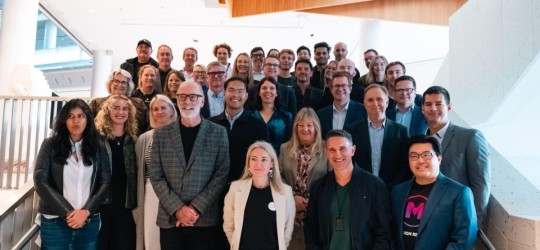
Mayoral Celebratory Event: honouring Auckland’s Hi‑Tech Awards finalists
26 Jun 2026
As Techweek26 built toward its final nights of celebration, Auckland Council brought the sector together for something new: a Mayorals celebration to recognise the 29 Auckland-based finalists heading into the…
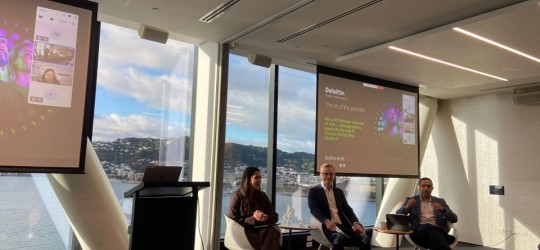
We can't hire our way out of this: Demographics, productivity and the AI choices facing New Zealand (event recap)
26 Jun 2026
At Techweek26, principal sponsor Deloitte hosted a conversation with an intentionally blunt title: We can’t hire our way out of this. The focus landed quickly.