Unlocking Growth: How Subscription and Embedded Payments Are Transforming Kiwi SaaS Businesses
By Techweek Team
28 May 2025
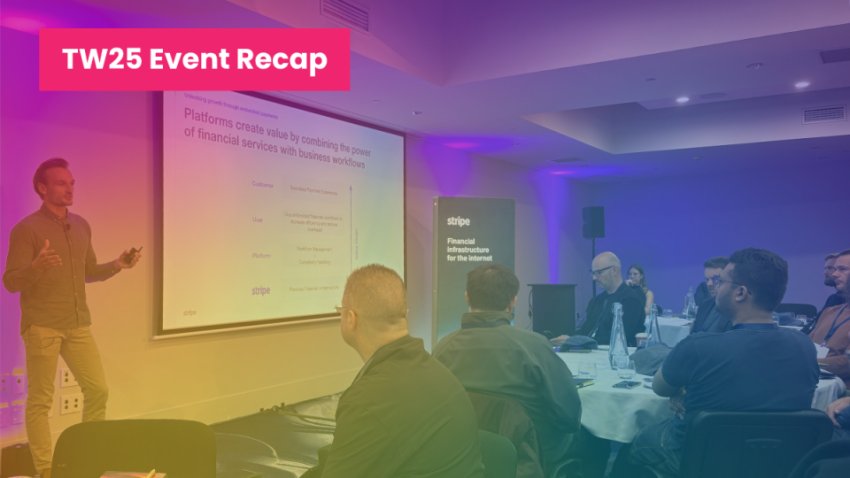
The inaugural SaaS community event hosted by Stripe as part of Techweek25 offered Kiwi tech companies a masterclass in monetisation strategies. Featuring insights from Stripe's leadership team and successful platform partners, the session explored how payment infrastructure is becoming a catalyst for exponential growth in the subscription economy.
The Shifting Landscape of SaaS Business Models
Ben Hanna, Country Manager for Stripe in New Zealand, opened the session by highlighting how the digital economy is outpacing traditional sectors. "Today, the global digital economy is valued at 20 trillion US dollars, Hanna explained. "The really interesting thing is it's growing two and a half times faster than the broader economy."
For New Zealand, with its small export-oriented economy and remarkable innovation capacity, this digital acceleration represents a significant opportunity. The Ministry of Foreign Affairs and Trade predicts that approximately 70% of new value created in the global economy will come through digitally enabled platforms—an area where Stripe is supporting 15,000 platforms globally, powering more than ten million businesses.
Hanna highlighted recent product launches designed to support New Zealand's digital economy, including Xero’s Tap to Pay on iPhone and NZ BECS Direct Debit, an ideal payment method for subscription-based business models.
The Subscription Economy: New Zealand's Growth Frontier
Eimear Broderick, Head of Billing Solutions for Asia Pacific at Stripe, shared compelling research showing that 36% of New Zealand businesses surveyed are actively planning to implement subscription-based models in the next one to three years—higher than in Australia and significantly higher than the APAC average.
"This signals that there is incredible growth potential in the subscription economy for New Zealand," Broderick noted. However, the research also revealed a concerning gap: 32% of New Zealand businesses are operating with legacy or mixed payment infrastructure, more than double the challenge faced by peers in Australia and across APAC.
This creates what Hanna called the "high trust, low confidence paradox" in New Zealand. "Kiwi businesses have far lower concerns about security and fraud compared to Australia at 33% and APAC average of 38%. However, significantly higher concerns in our ability to support modern payment approaches and subscription billing."
The Evolution of Pricing Models
A significant trend highlighted by Broderick is the shift away from simple flat-rate pricing toward more sophisticated usage-based models. This transition has accelerated even faster than anticipated with the rise of AI.
"We're actually seeing this phenomenon expand at a rate that we didn't even expect to happen," Broderick explained, citing Intercom as an example of a company that has moved from per-seat pricing to per-resolution pricing—monetising based on the value delivered to customers rather than traditional subscription metrics.
For businesses considering pricing changes, Stripe offers out-of-the-box solutions including hosted pricing tables, optimised checkout pages, and customer portals. Broderick noted that businesses adopting Stripe's optimised checkout pages see an average revenue uplift of 11.9%.
From SaaS to Financial Services: The Embedded Payments Opportunity
JJ Lecocq, Head of Platforms for Australia and New Zealand at Stripe, took the conversation in a new direction by exploring how SaaS businesses can generate revenue through embedded payments.
"Embedded finance has been around for years and decades," Lecocq explained, referencing historical examples like the Medici family embedding tables within marketplaces in the 15th century. The modern opportunity, however, is unprecedented—BCG estimates embedded finance represents a seven trillion dollar opportunity globally.
Lecocq outlined how SaaS platforms typically evolve through predictable stages:
-
Starting as pure SaaS businesses
-
Adding payment capabilities as customers request them
-
Initially allowing customers to choose their own payment providers
-
Consolidating on one partner to create a productised payment experience
-
Expanding into broader financial services
This evolution has proven remarkably profitable. "Shopify is today generating over 70% of their revenue from embedded financial services on that platform," Lecocq noted. "Squarespace and Lightspeed both report that they have over 50% of their revenue from payments. So payments is not just a feature, it's a catalyst for exponential growth."
Re-Leased: A Kiwi Success Story
Gal Thompson, VP of Asia Pacific at Re-Leased, provided a compelling case study of how a New Zealand SaaS company successfully implemented embedded payments. Re-Leased, a commercial real estate software used by property managers and landlords, processes $15 billion annually in rent invoices.
"Collecting rent is probably the most important thing that you've got to do as a property manager," Thompson explained. "It felt like a very natural progression to make sure that we help our customers collect rent faster, make their jobs better, but also that they're very ‘sticky’."
Thompson shared how tenant behavior has evolved dramatically in recent years, with increasing demand to pay rent using credit cards—something that was unthinkable just five years ago. In APAC, 80% of all transactions through their platform are now via credit cards, with tenants willing to pay the convenience fees.
The implementation varied by region due to different regulations and customer expectations. Thompson explained how stricter regulations around fees required adapting their product before entering certain markets.
Advice for Launching Embedded Payments
When asked for advice for companies looking to launch embedded payments, Thompson emphasised several key points:
-
Choose the right partner early: "Shifting to a different one is a lot of work."
-
Leverage trusted global brands: "The Stripe brand is very well known and they're like, 'Oh yeah, it's Stripe. Okay, that's safe.'"
-
Start simple and iterate: "Don't build the perfect payments platform from day one... Don't wait for it to be perfect. Just start."
-
Expect continuous evolution: "As regulations change, as more payment methods change... it's constantly evolving and innovating."
What's Next for Payment Innovation
As the session concluded, the speakers highlighted how payment infrastructure will continue to evolve, with AI likely to play an increasing role in personalising payment experiences and reducing friction.
Thompson mentioned that Re-Leased is exploring AI agents for rent collection: "What's coming later on in the year is AI agents. Some of the agents will be chasing rent payments... without Re-leased Pay, the AI agents can't go and do it. So I think AI and Re-leased Pay have a really nice coupling."
Lecocq added that they're seeing similar innovations elsewhere, such as "a restaurant booking system actually implementing platform payments where an AI agent will answer any time of the day or night to allow a customer to book a table. Just an agent answering and sending a payment link afterwards."
For New Zealand SaaS companies, the message was clear: payment infrastructure is no longer just a utility but a strategic asset that can drive growth, increase customer stickiness, and open new revenue streams. Whether through sophisticated subscription models or embedded payment solutions, the companies that embrace these opportunities stand to gain significant competitive advantages.
Subscribe to the Techweek newsletter for updates straight to your inbox:
Recent news

The Niu Wave: Tech Futures — rangatahi, resilience, and rewriting the rules of who tech is for
26 Jun 2026
At Techweek26, The Niu Wave: Tech Futures produced by The Southern Initiative and Te Ngahere created a powerful space for rangatahi and whānau to hear directly from Māori and Pasifika…

Mayoral Celebratory Event: honouring Auckland’s Hi‑Tech Awards finalists
26 Jun 2026
As Techweek26 built toward its final nights of celebration, Auckland Council brought the sector together for something new: a Mayorals celebration to recognise the 29 Auckland-based finalists heading into the…
We can't hire our way out of this: Demographics, productivity and the AI choices facing New Zealand (event recap)
26 Jun 2026
At Techweek26, principal sponsor Deloitte hosted a conversation with an intentionally blunt title: We can’t hire our way out of this. The focus landed quickly.